Other Works

Continual Learning for 6-DoF Grasp Synthesis via Experience and Demonstrations

Giulio Schiavi1, Andrei Cramariuc2, Michael Pantic1, Roland Siegwart1
CoRL 2026

Our method continually adapts single-view 6-DoF grasp synthesis through grasp experience and optional user demonstrations recalled from memory.

Abstract

Most current grasp synthesis systems are trained offline and remain fixed during deployment. While this works well when deployment conditions resemble the training data, performance can degrade when robots encounter conditions they have not seen before, such as unfamiliar objects. In this work, we present a continual-learning framework for single-view 6-DoF grasp synthesis for a parallel-jaw gripper in cluttered scenes. Rather than finetuning a large parametric model, our method adapts through memory in a learned embedding space: grasp outcomes update future grasp scores, while optional user demonstrations are recalled and transferred to new scenes as additional candidate grasps. We evaluate our method in simulation and in extensive real-world experiments comprising over 1500 grasp trials. We show that our method matches the performance of existing 6-DoF grasping baselines even before adaptation, improves online on unseen objects from categories absent or underrepresented during training, and supports long-horizon continual learning with limited forgetting. In real-world experiments, our method reaches over 90% success rates on several challenging object categories after only 50 online grasp attempts.
How the Method Adapts

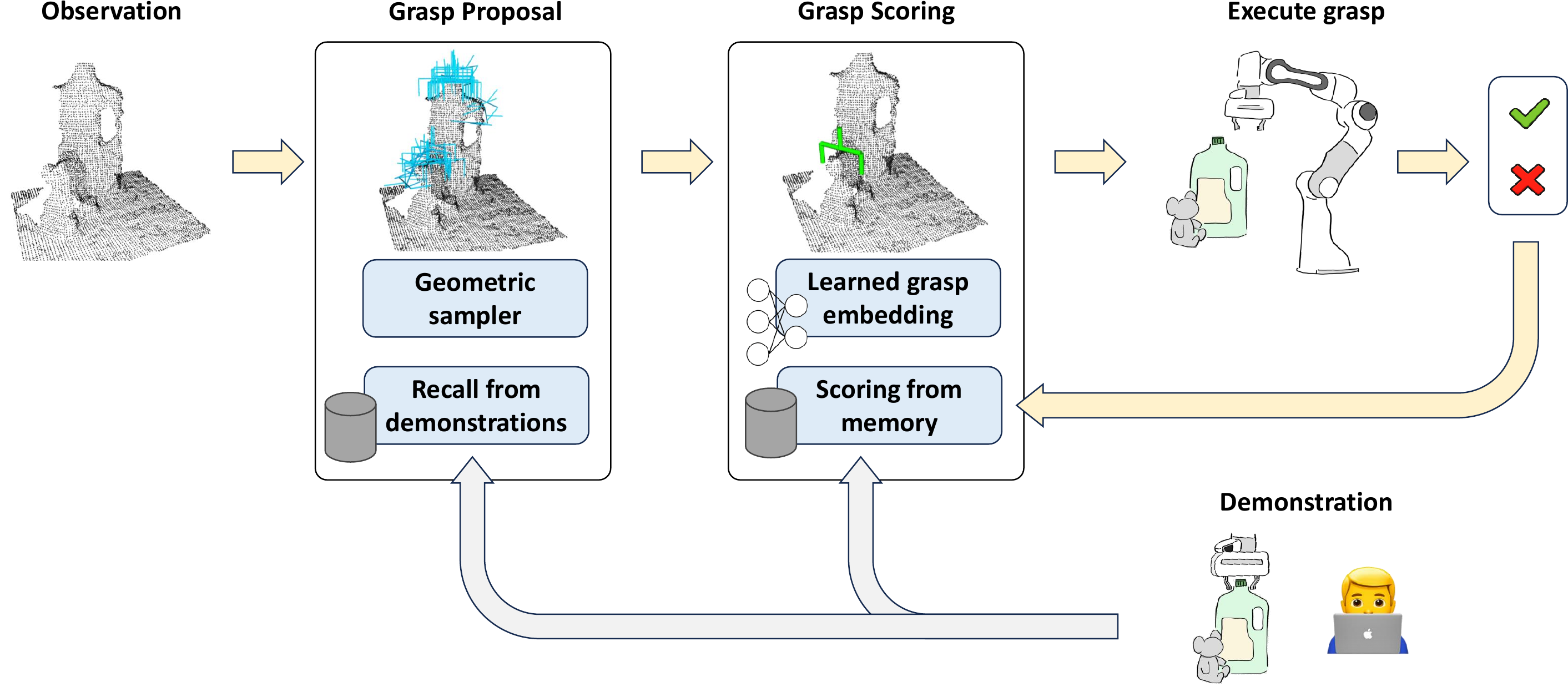
Our grasp synthesis pipeline can keep learning after deployment—without updating network weights.

Adaptive proposals

Grasp recall through registration

We generate grasp proposals using heuristics (e.g. contact, side, top-down grasps) but also add grasps recalled from demonstrations. This allows users to introduce new grasp modes, when normal sampling is not enough.

Adaptive scoring

Non-parametric grasp prediction

We estimate grasp success from nearby experience in a learned embedding space, enabling immediate adaptation from successes and failures during deployment.

Closed-loop learning

The entire pipeline improves during deployment

Diagram of the continual-learning grasp synthesis pipeline

Outcome memory continually updates grasp scoring, while demonstration memory expands grasp proposal. Together, they let both core stages of synthesis adapt online.

BibTeX

@misc{schiavi2026continuallearning6dofgrasp,
  title={Continual Learning for 6-DoF Grasp Synthesis via Experience and Demonstrations},
  author={Giulio Schiavi and Andrei Cramariuc and Michael Pantic and Roland Siegwart},
  year={2026},
  eprint={2610.01301},
  archivePrefix={arXiv},
  primaryClass={cs.RO},
  url={https://arxiv.org/abs/2610.01301}
}